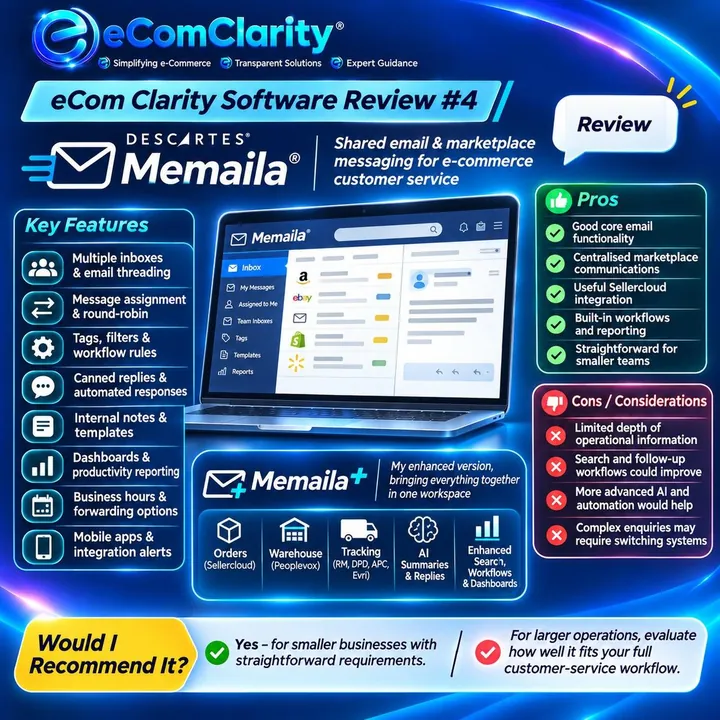
What Memaila is, and what it is not
Memaila is a shared inbox for customer service teams. Email arrives in a team queue rather than in somebody’s personal mailbox, gets turned into a thread, and is assigned to one agent at a time. Several people can watch the same inbox without stepping on each other, and the customer sees a reply from the team address rather than an individual’s.
It comes from Descartes Sellercloud, and the Sellercloud connection is the part that makes it more than a shared mailbox. When a customer emails about an order and that address is on a Sellercloud customer record, the thread is created with recent orders, RMAs and other details attached. If your marketplace messaging is set up for Amazon, eBay or Walmart, those messages land in the same queue as email.
The boundary that decides whether it fits
Memaila manages a conversation; it does not resolve an order. It can show you that a customer has two orders and an open RMA, but it cannot tell you where the parcel is, what the warehouse has against the SKU, or which carrier scan was missed. That is not a criticism of the inbox — it is simply the edge of the product, and it is the edge we kept hitting.
How this review was done
We have used Memaila since February 2025, so the practical judgements here come from running a customer-service queue on it rather than from a demo. The feature descriptions are taken from Sellercloud’s own knowledge base and product page, read on the dates below, so they can be checked.
- The Memaila product page on sellercloud.com, read 9 November 2026
- The “Memaila Setup” knowledge base article: inboxes, threads, workflows, the Sellercloud automation settings and the full feature list
- The Sellercloud pricing page, to establish what is and is not published
- Twenty months of running the inbox in a live multichannel operation
- Our own Memaila+ build, which is described separately and is not a Descartes product
Where we cannot evidence something we say so, particularly pricing, which is not published, and the depth of the marketplace integrations, which we use for email and reporting but have not tested across every channel.
The inbox: threads, assignment and labels
The basics are done properly. You can run more than one team inbox — support, sales, marketplace — and invite the relevant people to each, so not everybody sees everything. A thread belongs to one agent at a time, which is the single most important design decision in a shared inbox: two people cannot both quietly assume the other is answering.
Assignment can be manual or automatic. Manual is a supervisor dragging work around, or an agent picking up from the queue. Automatic is either a round-robin configuration that spreads new threads across the team, or a workflow rule that routes by condition. That is the right ladder for a growing team: start manual, add round-robin when the volume hurts, then add rules when the routing itself becomes the job.
Labels and tags sort the queue for filtering, and “intelligent thread control” groups replies so a long back-and-forth stays one conversation rather than five. Escalation exists as a first-class action, which matters because the alternative — forwarding to a manager and losing the thread — is how context disappears.
One small feature deserves a mention because it is the sort of thing customers notice: agents reply from the team address, and the product page makes a point of keeping personal email addresses hidden. In an operation where staff turnover is real, that is worth having.
The automation: workflows, canned replies and the boring things that save time
This is where a shared inbox earns its keep, and Memaila’s list is solid. Workflows execute actions automatically when conditions are met. Canned responses handle the questions that have the same answer every time. Note templates do the same for internal notes, so an agent does not retype the same handover. The Auto Response Queue manages delayed auto-responses, which is the detail most tools get wrong: an immediate “we have your email” is useful, five identical ones are not.
| Capability | What it does |
|---|---|
| Workflows | Automatic actions when a thread meets your conditions |
| Round robin | Spreads new threads across the team automatically |
| Canned responses | Pre-written replies for common questions |
| Note templates | Reusable internal notes for handovers and escalations |
| Auto Response Queue | Controls delayed automatic replies |
| Email settings | Autoresponder, forwarding and redirection |
| Time zone management | Correct timestamps, and auto-responses that respect business hours |
| Alert settings | Warns you when an integration stops working |
| Two-factor authentication | Second factor on account sign-in, configured in our own account settings |
| Escalation | Moves a thread up without losing its history |
The email settings are more complete than the marketing suggests: autoresponder, forwarding and redirection are all configurable, and time zone management governs both timestamps and the business-hours behaviour of automatic replies. If you are answering customers in more than one country, that is the difference between a helpful auto-reply and one that arrives at 3am telling somebody to expect an answer during office hours they are not in.
Alert settings deserve their own line. Integrations fail quietly — a marketplace connection drops, messages stop arriving, and nobody notices until a customer complains about being ignored. A warning that the integration is unhealthy is unglamorous and genuinely valuable.
Integrations and fittings: the plumbing is the product
Memaila can host a team address for you — an @memaila.co mailbox — or connect your existing customer service address over IMAP and SMTP. That second option is the one most established operations need, because the address is already in the wild, in signatures, on invoices and in marketplace settings.
On top of the mailbox sit the connections that make it an ecommerce tool: Sellercloud for customer, order and RMA context; Amazon, eBay and Walmart for marketplace messaging; and Slack for teams who want to answer from a channel rather than a browser tab. Mobile apps for Android and iOS mean the queue is not tied to a desk.
The Sellercloud automation
This is the part the marketing undersells. Emails from an address on a Sellercloud customer record become threads with the recent order and RMA detail attached, and the optional settings go further than a normal inbox can.
| Automation | What it does |
|---|---|
| Order context on the thread | Recent orders, RMAs and customer detail attached when the sender matches a Sellercloud customer |
| Post to order notes | Writes the full conversation into the order’s Customer Instructions tab in Sellercloud, so the history lives with the order |
| Order hold on cancellation | A cancellation email places the order on hold, so it cannot be shipped |
| Hold picked orders too | A second setting applies that hold regardless of picking status, including Fully Picked orders |
| Return reasons into RMAs | Marketplace return reasons come through to the RMA — behaviour we see in our own operation, and the thing that makes the returns data worth reporting on |
The cancellation hold is the one that pays for itself. A customer cancelling at 9am is a parcel that does not leave, a return that does not happen and a courier charge that is never incurred. The second setting matters more than it sounds: without it, an order already picked is the exact order that ships anyway, which is the expensive version of the mistake.
What the Sellercloud link actually gets you
Worth testing in a demo with your own data rather than a clean sample, because the value depends entirely on how well your customer records match the addresses that email you. Where they match, the thread arrives already knowing which order it is about; where they do not, you are back to searching.
Reporting: productivity, not outcomes
Productivity Insights provides dashboards and reporting on the team’s workload and performance. For a supervisor that is the useful view: who is carrying what, how quickly threads move, where the queue bunches up. It is reporting about the inbox, not about the customer’s problem, and that distinction matters when you are trying to work out why resolution is slow rather than why answering is slow.
Pricing
No price for Memaila is published. The product page routes to a demo request, and Sellercloud’s pricing page covers its platform plans — which start from $1,349 a month for Essentials — without listing Memaila as a line item. Ask directly, and ask what the price depends on: mailbox count, user count or marketplace connections.
Treat this section as an absence rather than a gap in our research. We checked the product page and the pricing page on 9 November 2026; there is no figure to quote, and inventing a range would be worse than saying so.
Where it is strong, and where it falls short
Strong
- The core inbox is well built: multiple inboxes, single-owner threads, labels, tags and sensible filtering
- Marketplace messaging in the same queue as email, which is the reason most ecommerce teams look at it
- Sellercloud context on the thread, so an agent can see the customer’s recent orders and RMAs without opening another system
- The automation around that context: cancellation holds that stop a parcel, order-note posting and marketplace return reasons in the RMA
- Workflows, canned responses and note templates, which together remove most of the retyping
- Business hours, time zones and autoresponder settings that hold up for international customers
- Reporting on team productivity, which is what a supervisor needs first
Weaker
- Limited wider warehouse and courier visibility: the thread can tell you an order exists, not where the parcel is or what the warehouse sees
- Search and follow-up, which in our experience could carry more of the daily workload than they do
- AI and automation beyond rules: Sellercloud’s published feature list includes none, so nothing reads the thread, summarises it or drafts the reply for you
- Complex enquiries, which end up back in the other systems that hold the actual answer
The last point is the one that decides the fit. Answering an email is one job; resolving the customer’s problem is another, and in our operation the second job meant opening Sellercloud, Peoplevox and a carrier tracking page before we could type a useful sentence. Memaila made the first job orderly. It did not make the second one quicker.
What to ask Sellercloud in a demo
- Show our own mailbox connected over IMAP and SMTP, not a hosted sample.
- What exactly is attached to a thread when the sender matches a Sellercloud customer — orders, RMAs, tracking?
- How do workflows handle a thread that changes, for example a delivery question that becomes a return?
- What does the Auto Response Queue do when a customer replies to an automatic message?
- Which marketplace messages arrive here, and what happens to anything Walmart or Amazon blocks?
- What is included in the price, and what is priced per mailbox, per user or per marketplace?
- How does the reporting handle a thread that is answered quickly but resolved slowly?
- Can an agent see carrier tracking inside the thread, or only a link out?
Memaila+: before and after
Read this first
Memaila+ is our own work. It is not a Descartes product, Descartes has had no involvement in it and has not endorsed it, and “Memaila+” is a working title rather than an official name. It is included here because a review that explains where a product stops is more useful when it can show what the next step looked like. Nothing in this section is a statement about Descartes’ roadmap.
Memaila+ is a shared-inbox layer built around Memaila rather than instead of it. Memaila remains the mailbox of record: conversations still arrive, thread and assign there. Memaila+ adds the context an agent needs to finish the job in the same window, and a copilot that reads the thread without being allowed to send anything on its own.
Before: Memaila as it ships
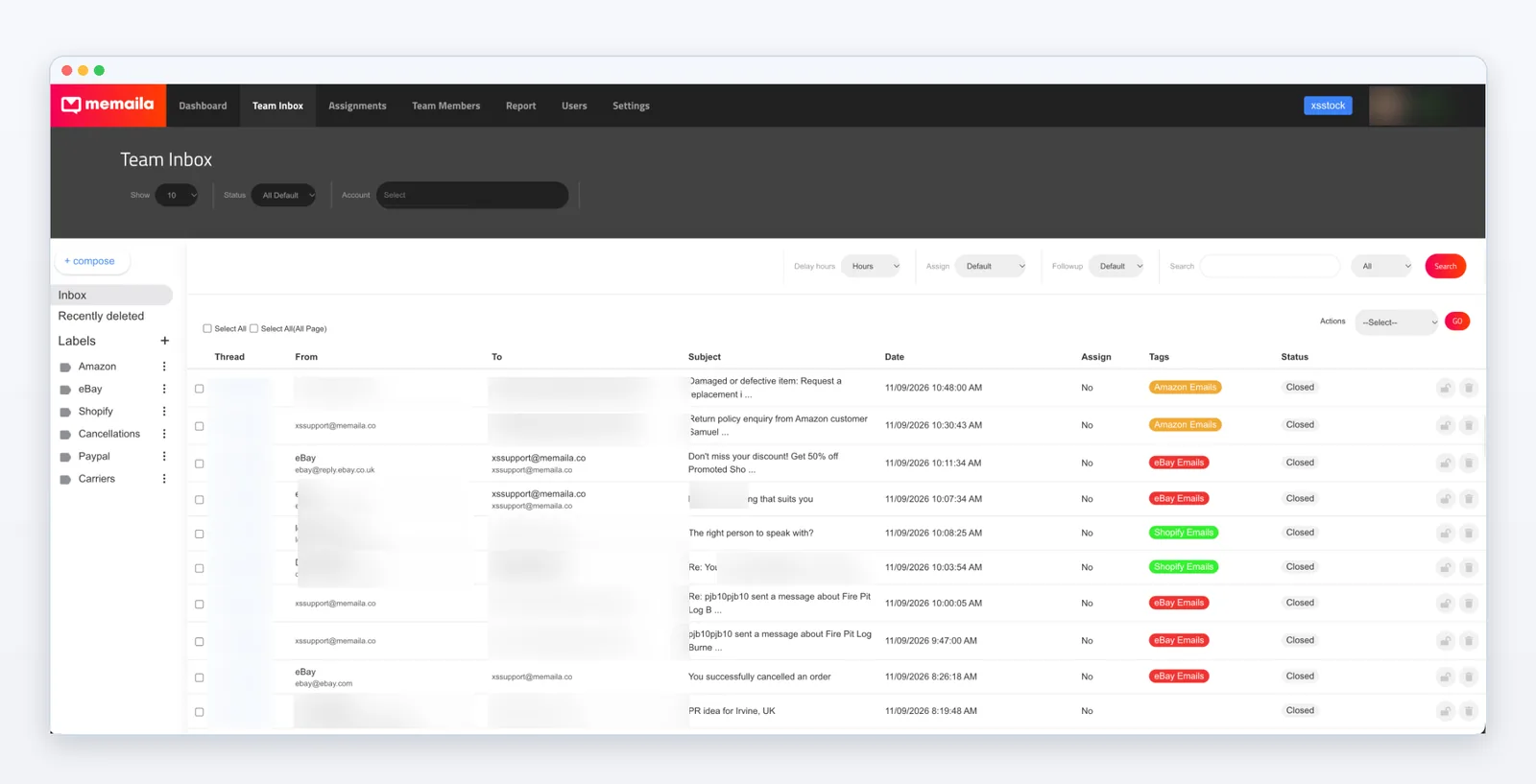
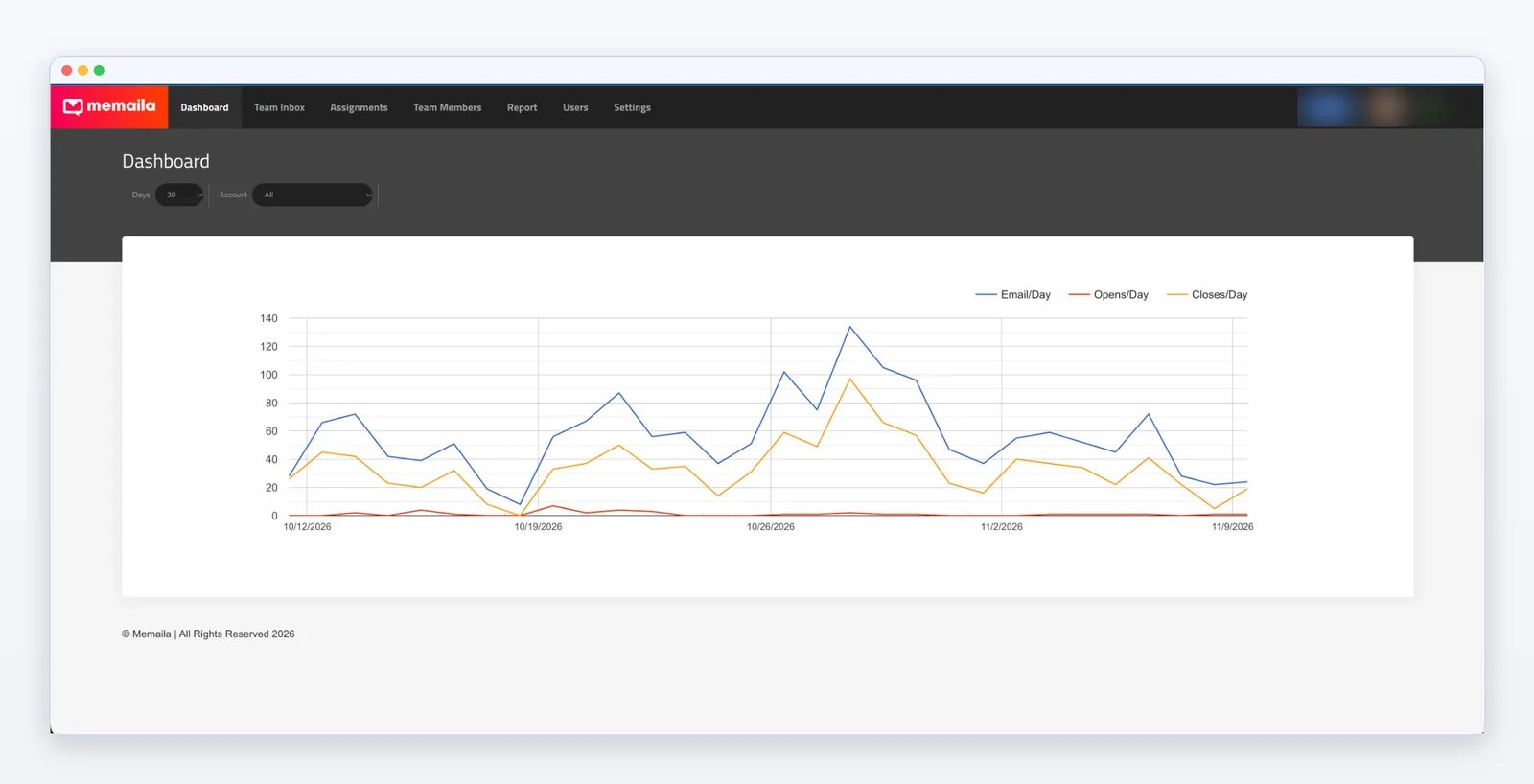
These are the native screens, taken from our own operation. A team inbox with marketplace messages tagged by channel; a dashboard counting emails, opens and closes; a conversation that shows the customer’s message but nothing from the order, the warehouse or the carrier. It is a competent shared inbox doing exactly what it says.
Before
After
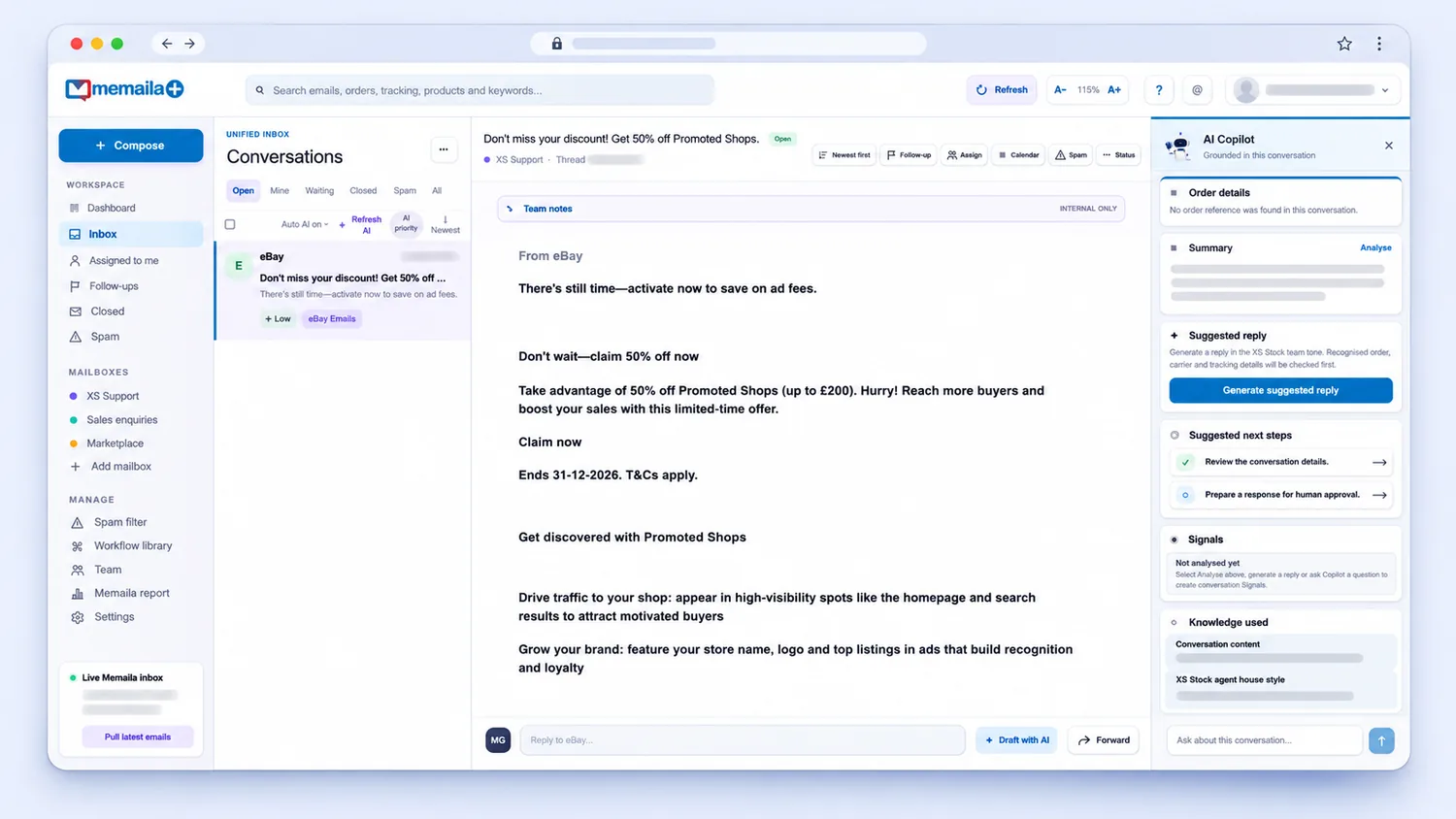
Screenshots are from our own operation; customer, order and staff details are blurred.
Before
After
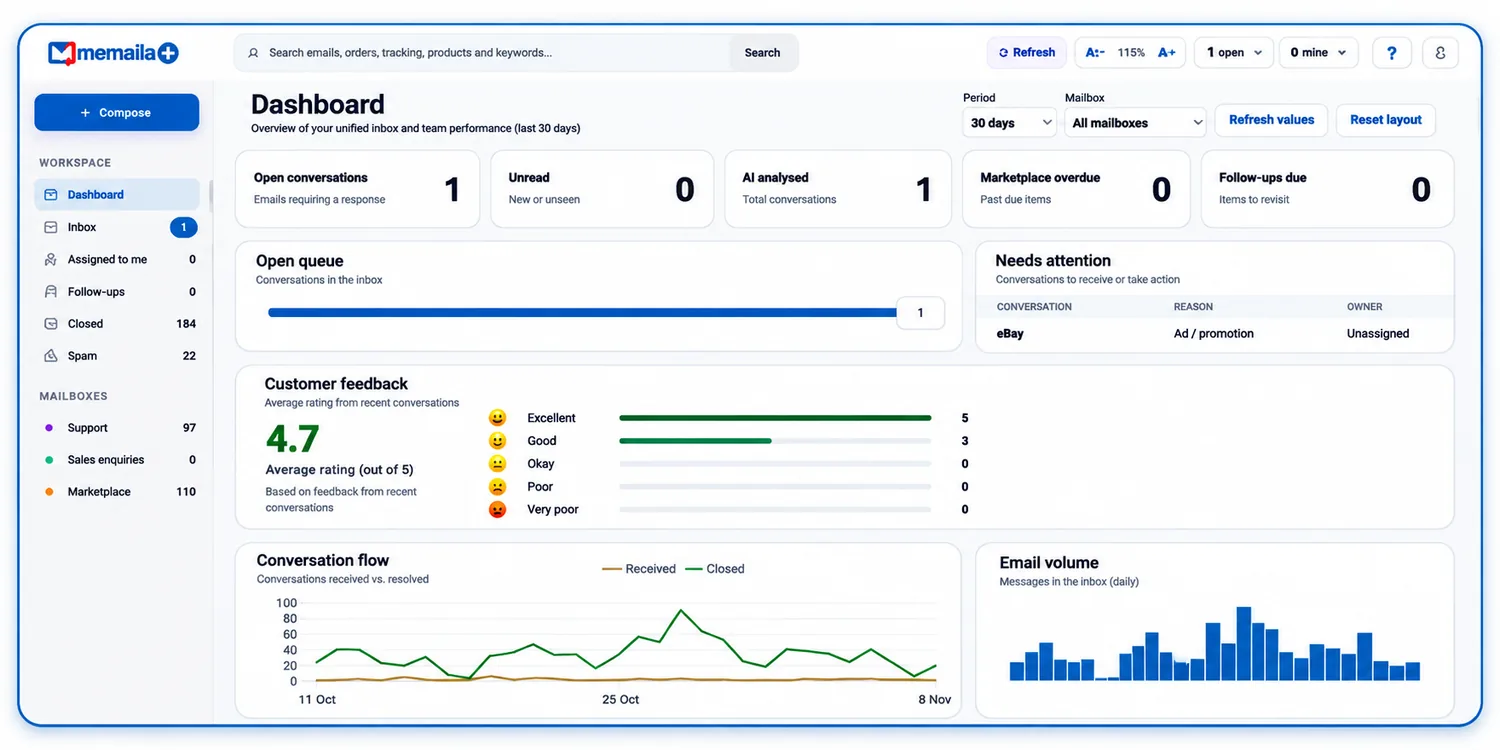
Before
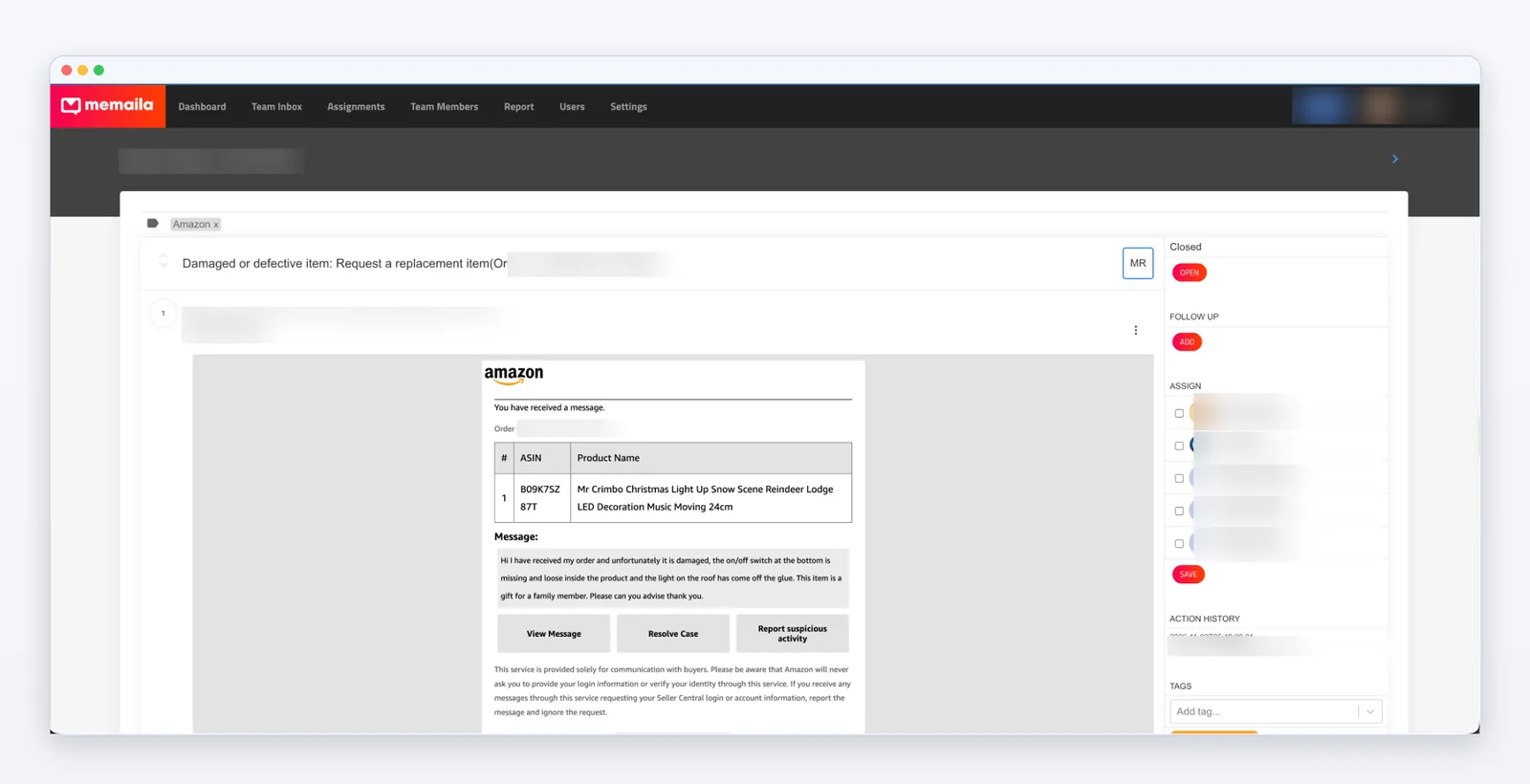
After
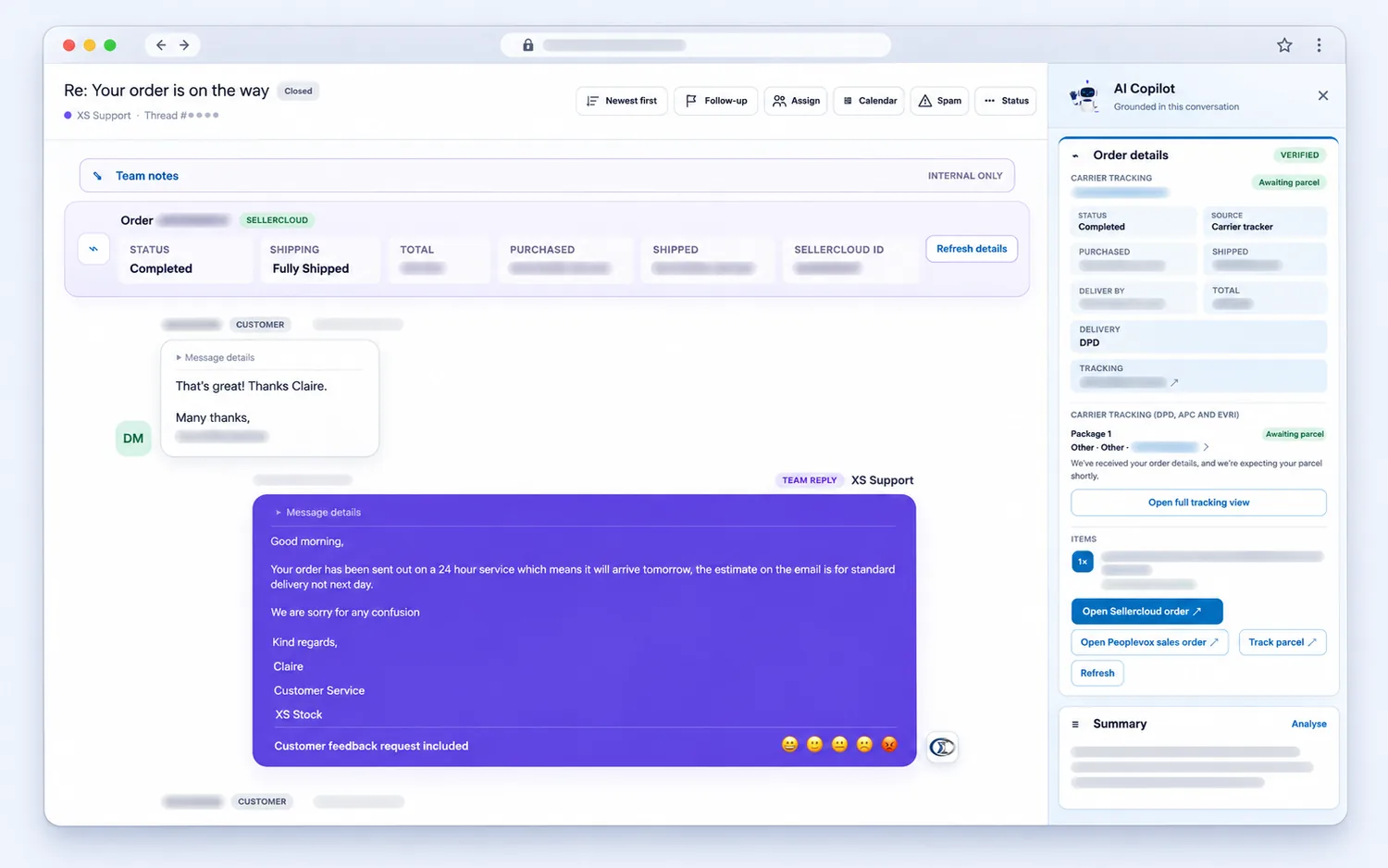
After: what the extra layer adds
The right-hand panel is the point of the whole thing. For the conversation in view it shows the order from Sellercloud, the carrier status and scan history, the items, a summary, a suggested reply and suggested next steps, plus the signals the model picked up: why the customer is writing, how they sound, how urgent it is and how confident the assessment is. Marketplace and carrier tracking sit in separate, clearly labelled blocks rather than being blended into one “status”, because two systems disagreeing about a parcel is exactly the moment an agent needs to see both answers.
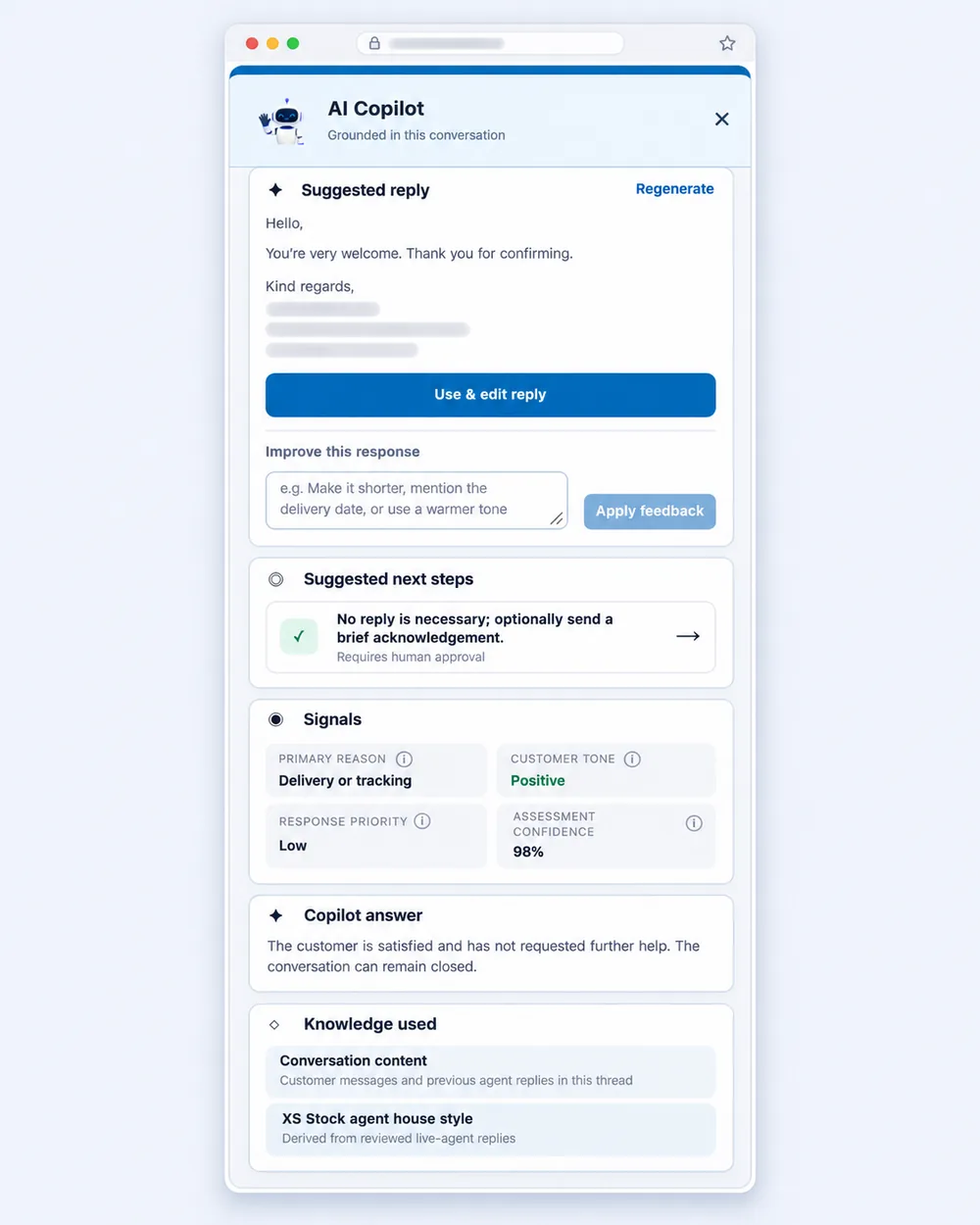
The copilot summarises a thread, identifies intent and priority, extracts order references and drafts a reply. It does not send. Sending is an explicit human step, and credentials for the mailbox never reach the browser: the browser talks to our server, the server talks to Memaila. That boundary matters because an email is untrusted input, and a language model reading email should not be able to turn a sentence inside one into an action on a customer account.
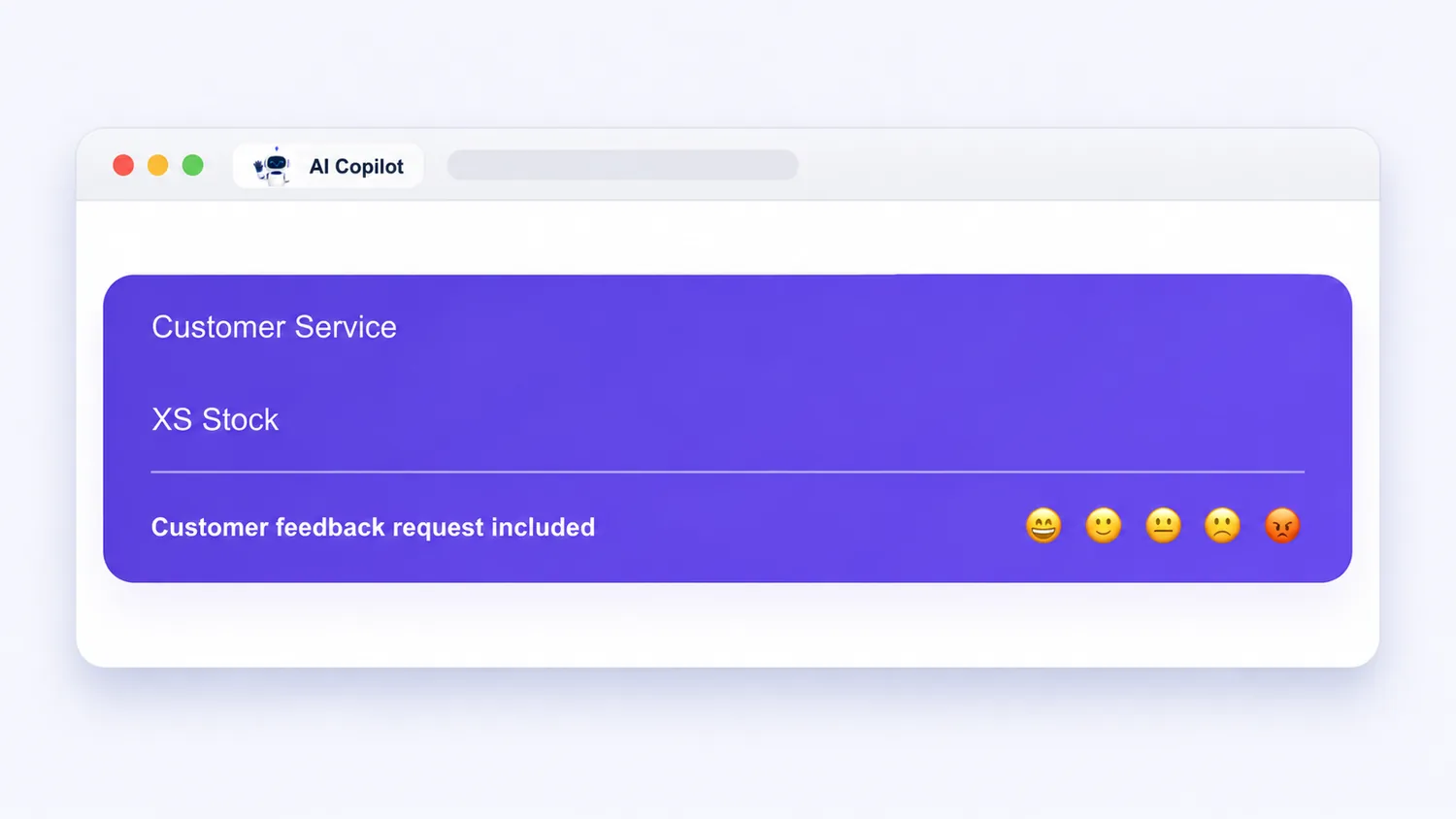
Everything runs through a server-side Memaila adapter that normalises the documented legacy API and the richer private API-v2 behind one internal contract, so the interface is not built on a single endpoint that might change shape. Sellercloud is the primary order source. Amazon and eBay tracking come back separately. Shopify supplies an exact-SKU website price, but only once a matching order has been found, so a price cannot be quoted against the wrong product. Carrier status and scan history are cached, with official tracking links as a safe fallback.
Polling, checkpoints and reconciliation run underneath because a dependable supported webhook was not confirmed. That is a less elegant design than an event stream and a deliberate one: an inbox that silently stops updating is worse than one that refreshes on a schedule and says when it last did.
The practical difference is small and constant. Instead of reading a thread, opening Sellercloud, opening the warehouse system, opening a carrier page and then writing, an agent reads one screen, checks the context, edits the draft and sends. The AI does the reading and the lookup; the person keeps the judgement.
The verdict
Memaila does a good job of managing customer emails, and its Sellercloud automation deserves more credit than it gets. Stopping an order the moment a customer asks to cancel — including one already picked — saves real money in parcels that never leave and returns that never arrive, and it is the kind of feature you only value once you have paid for its absence.
The limitation is not a bug in the inbox; it is the boundary of the product. Managing an email and resolving an enquiry are different jobs, and the second one needs the order, the warehouse and the carrier in the same place as the conversation. In our operation that meant three other systems per enquiry, which is why we built the layer that closes the gap.
Would I recommend it? Yes, with a caveat that depends on your volume. If you answer a few hundred emails a month and the answers are in the thread, Memaila is a tidy, well-judged shared inbox. If your team spends more time looking things up than typing, evaluate the whole workflow — including what sits around the inbox — before you commit.
Evidence and sources
- Memaila product page: shared inbox, integrations, privacy model, feature list · Read 9 November 2026
- Sellercloud knowledge base, “Memaila Setup”: inboxes, assignment, workflows, reporting, mobile apps · Read 9 November 2026
- Sellercloud pricing page: what is published, and what is not · Read 9 November 2026
- Our own Memaila+ build and its write-up, which is not a Descartes product · Author’s own
- Twenty months of running Memaila in a live operation · Author’s own
Independence
eCom Clarity was not paid for this review and Descartes Sellercloud has no influence over its content. There is no referral or affiliate arrangement. The product facts come from Sellercloud’s own documentation, read on the date below; the judgements about day-to-day use come from our own operation since February 2025. The Memaila+ section at the end describes a system we designed and built ourselves. It is not a Descartes product, Descartes has not reviewed or endorsed it, and “Memaila+” is a working title rather than a name we have cleared with anyone.
Spotted something wrong, or used this product yourself? Tell us and we will correct or add it.