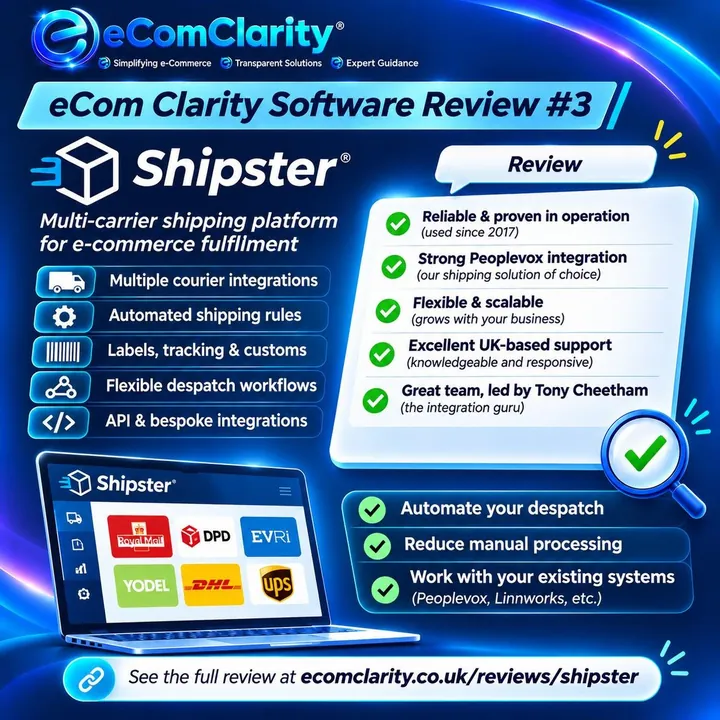
What Shipster is, and what it is not
Shipster sits between your warehouse system and your couriers. Orders arrive from the WMS or the sales channel, the shipping rules decide how each one goes, and Shipster produces the label, the documents and the tracking. Everything else in the warehouse stays where it is: stock still lives in the WMS, and the picker still works from the WMS screen.
It is built by Oddsphere Ltd in Manchester, and it has been a shipping product for long enough to look like one: a desktop install, a rules engine, a courier estate, and a support line staffed by people who can change a rule rather than file a ticket. Its selling point is not the length of the courier list. It is that the rules can match how your warehouse actually works, including the awkward parts.
The boundary that decides whether it fits
Shipster does not hold stock, take orders or run a pick. It is the despatch layer, and it is deliberately agnostic about what sits behind it: Peoplevox, Linnworks, Swan Retail, Futura, Ordorite, Minster or your own system. If you are looking for a system to run the warehouse, this is the wrong part of the stack. If you are looking for the bit that turns a picked order into a correct parcel, it is the right one.
How this review was done
We have used Shipster since 2017, which makes this review different from most of the ones on this site: the judgements about reliability, support and how the platform behaves in a busy week come from running it, not from a demo. The facts about pricing, couriers, documents and integrations come from Shipster’s own site, read on the dates below, so you can check them.
- The pricing page and its licence calculator, read 9 November 2026
- The homepage and about page: platform description, support model, product list
- The shipping automations page, which lists what the rules engine can control
- The integrations page and the Peoplevox integration pages
- The case studies and testimonials, which are the vendor’s own customer stories
- Nine years of running Shipster alongside Peoplevox and Linnworks in a live operation
Where I have not tested something I say so. That applies to products we do not use, such as Shipster Returns and the temperature-controlled shipping option.
What it actually does
The rules engine
This is the product. Courier selection can key off destination, weight, order value, delivery promise, sales channel, SKU or your own attributes, and the service can be upgraded or downgraded when a rule is met. When the data point exists, the rule can be written for it, which is the sentence Shipster puts on its own site and, in my experience, means what it says.
The rules go well past choosing a courier. Postcode and address checks can block or reroute a shipment. Store collections can switch the delivery address and label for click-and-collect. Parcels can be split or bundled on weight, item count, dimensions or courier limits. Packing instructions pop up at the bench for fragile, age-restricted or gift orders. Problem orders go into review queues instead of holding up the line, and seasonal boosts switch services for Black Friday, Christmas or a carrier strike without retraining anyone.
Labels, documents and customs
Shipster prints the courier label, the notification label, the barcode and the handling sticker in one flow, then generates the commercial invoice, CN22/CN23 and paperless trade documents where the carrier supports them. The site states IOSS, EORI, Windsor Framework and ICS2 compliance for the customs paperwork, which matters more every year for a UK operation selling into the EU.
After-sales and returns
Around the core despatch product sit two others. Shipster After-Sales provides branded tracking pages, delivery notifications and product recommendations after despatch, and Shipster Returns is a returns portal with remote condition inspection and disposition rules. We have not run either, so treat that as the vendor’s description rather than a test result.
The API
There is a Shipping API for adding courier services and automated despatch to your own system, and a separate Return Shipping API. That is how Shipster reaches systems it has no pre-built connector for, and it is the honest answer to “do you integrate with ours?” on any software page: probably, either natively or through the API.
Integrations: Peoplevox first, and the long tail behind it
The Peoplevox integration is the one that matters here, because it is the pairing we used for years. Orders and inventory synchronise between Peoplevox and the other systems in the chain, and despatch happens on the Peoplevox screen through mobile dispatch: the picker or packer does not open a second application to print a label, which is the difference between a process that survives peak and one that does not. Tracking comes back to Peoplevox as part of the despatch confirmation.
Beyond Peoplevox, the site names Linnworks, Swan Retail and TRIMS, Futura, Ordorite, Minster WMS, Shopify and Amazon Shipping, with a Linnworks-to-Peoplevox connector for operations running both. The courier estate is where the number gets quoted: “over 150 leading couriers” on the about page, and “150+ leading couriers, WMS and eCommerce platforms” on the homepage, so treat 150 as a combined count rather than a courier count. Royal Mail is an official 3PI partner, which is worth asking about in the demo: accreditation usually buys better rates and fewer surprises than an unofficial connection.
| Group | What the site names |
|---|---|
| Warehouse and ERP | Descartes Peoplevox, Linnworks, Swan Retail and TRIMS, Futura, Ordorite, Minster WMS |
| Sales channels | Shopify, with channel workflows for WooCommerce, Magento, Amazon, eBay, Linnworks and Brightpearl |
| Couriers | The site quotes 150+ across couriers, WMS and platforms, with Royal Mail as an official 3PI partner and Amazon Shipping among the partners |
| Build your own | Shipping API for courier services and automated despatch, and a separate Return Shipping API |
For anything outside the list, Oddsphere builds the integration. That is how our own Linnworks-to-Peoplevox connector came about in 2017, and it is still the model: describe the workflow, they scope it, you get a custom build rather than a workaround.
- Our Peoplevox review · the warehouse system Shipster has been despatching from in our operation since 2017.
Pricing: per licence, four minimum, no per-label charge
Shipster publishes its pricing, which is rare in this category, and it is priced the way a warehouse thinks rather than the way a SaaS dashboard does. A licence covers one courier integration on one workstation installation, and costs £50 a month. The minimum commitment is four licences, so the floor is £200 a month. On top of that there is a one-off onboarding fee: £2,500 on a rolling agreement, or £1,500 if you commit for two years.
| Component | Price | How it works |
|---|---|---|
| Licence | £50/month each | One courier integration on one workstation |
| Minimum | 4 licences = £200/month | The bill reflects the highest number of licences used that month |
| Worked example | 3 benches × 4 couriers = 12 licences = £600/month | Licences are counted per courier enabled on each workstation |
| Onboarding | £1,500 (2-year) or £2,500 (rolling) | Courier setup, rules, integrations, workflow build, training |
| Per label | None | No per-shipment charge, no feature tiers |
| Users | Unlimited | Licences are per workstation and courier, not per person |
Do the maths on carriers and benches
This is the honest caveat in the pricing model: cost multiplies. Two benches using four couriers is eight licences, £400 a month. Five benches using six couriers is thirty, £1,500 a month, before onboarding. That is still predictable, and there is no per-label charge, but it rewards getting the workstation and courier design right before you buy. If you only need one courier on one bench, the four-licence minimum makes this more platform than you need.
Two details worth checking on the call, because they are where the bill moves: licences are self-serve and charged at the highest number used in the month, so a seasonal extra bench costs a month rather than a contract. And custom integrations or anything bespoke sit outside the licence, which is a scoping conversation rather than a price list.
Support: the part that has kept us on it
Shipster staffs a support line 24/7 with technical engineers rather than tier-one agents, and the site makes a point of saying what that means: no scripts, no chatbots, no escalation queue, and engineers with direct access to the client rules engine who can make same-day code changes. Our experience matches that description.
When something goes wrong in dispatch it is usually 4pm and a carrier is rejecting labels. What you want in that moment is someone who can read your rule, understand why it fired, change it, and tell you what they changed. That is the service Shipster has given us, and it is the reason I would rather pay for this than take a cheaper platform with an email queue.
On the people side, Tony Cheetham at Oddsphere has done much of the integration work around our setup, and he is both unusually knowledgeable about shipping data and easy to work with. Customer testimonials on the Shipster site say much the same thing. When your warehouse depends on parcels leaving every day, that is worth more than another feature on a roadmap.
The caveat is contractual rather than practical: I could not find a published uptime commitment or response-time SLA anywhere on the site. The promise is 24/7 human support, which is a service promise rather than a contractual one. If your business needs a signed SLA, ask for one and compare it with what you would get elsewhere.
Who it suits, and who it does not
A good fit when
- You despatch from your own warehouse across several couriers, and the rules differ by product, postcode or channel
- You run Peoplevox or Linnworks and want despatch without leaving the warehouse screen
- Your shipping rules have edge cases that an off-the-shelf tool cannot express
- You want published pricing and no per-label charge, so peak volume does not spike the bill
- You value being able to phone an engineer who can change your rules the same day
Not such a good fit when
- You despatch with one courier from one bench: the four-licence minimum is hard to justify
- You need a WMS or an OMS as well: this is the despatch layer, not the whole stack
- You want the courier relationship handled for you: that contract stays yours
- You need a signed uptime SLA rather than a support promise, unless the vendor will provide one
What to ask Shipster in a demo
- Map our couriers to our benches: how many licences does that actually come to, monthly?
- Show me a rule like ours, with three conditions, being written and changed live.
- What happens when a carrier API is down at 4pm: who is told, and what do we do meanwhile?
- Which of our integrations are native, which are API, and what would a custom build cost?
- What is in the onboarding fee, and what is charged extra?
- Can you provide a response-time SLA, and what does it cover?
- How do seasonal benches and courier changes get added, and how is that billed?
- Show me the tracking and customs documents for an EU order, not the happy-path UK one.
The verdict
Shipping is one of those things customers only notice when it goes wrong. Nine years in, Shipster is the part of our stack I have had to think about least, and that is the highest compliment I can pay a piece of warehouse software.
It is genuinely flexible rather than flexibly marketed. The rules engine does what it says, the pricing is published and predictable, and the support line is staffed by people who can change the system rather than read from a script. Those three things together are rare.
The caveats are real but narrow. The licence model multiplies with couriers and workstations, so the all-in figure needs calculating before you commit. Onboarding is a one-off cost on top. Bespoke work is scoped separately. And the support promise is not a signed SLA, which matters to some businesses more than others.
Would I recommend it? Yes, particularly for a UK warehouse despatching across several carriers on Peoplevox or Linnworks, where the rule flexibility pays for the licences. Nine years of running it is the recommendation.
Evidence and sources
- Pricing page and licence calculator: £50 per licence, four-licence minimum, onboarding fees · Read 9 November 2026
- Homepage and about page: platform description, support model, product list, Oddsphere ownership · Read 9 November 2026
- Shipping automations page: the full list of rule-controlled despatch tasks · Read 9 November 2026
- Integrations page and Peoplevox integration pages: connectors and the Linnworks-to-Peoplevox build · Read 9 November 2026
- Case studies and testimonials: named customers and customer quotes · Read 9 November 2026
- Contact page: Manchester address, support hours, 24/7 support line · Read 9 November 2026
- Nine years of running Shipster in a live operation · Author’s own
Independence
eCom Clarity was not paid for this review and Shipster has no influence over its content. There is no referral or affiliate arrangement. This review mixes material from Shipster’s own site, read on the date below, with my own experience of running the platform in a live warehouse since 2017. Where a point comes from that experience rather than from the vendor’s website, it says so.
Spotted something wrong, or used this product yourself? Tell us and we will correct or add it.