What Volo Commerce is, and what it is not
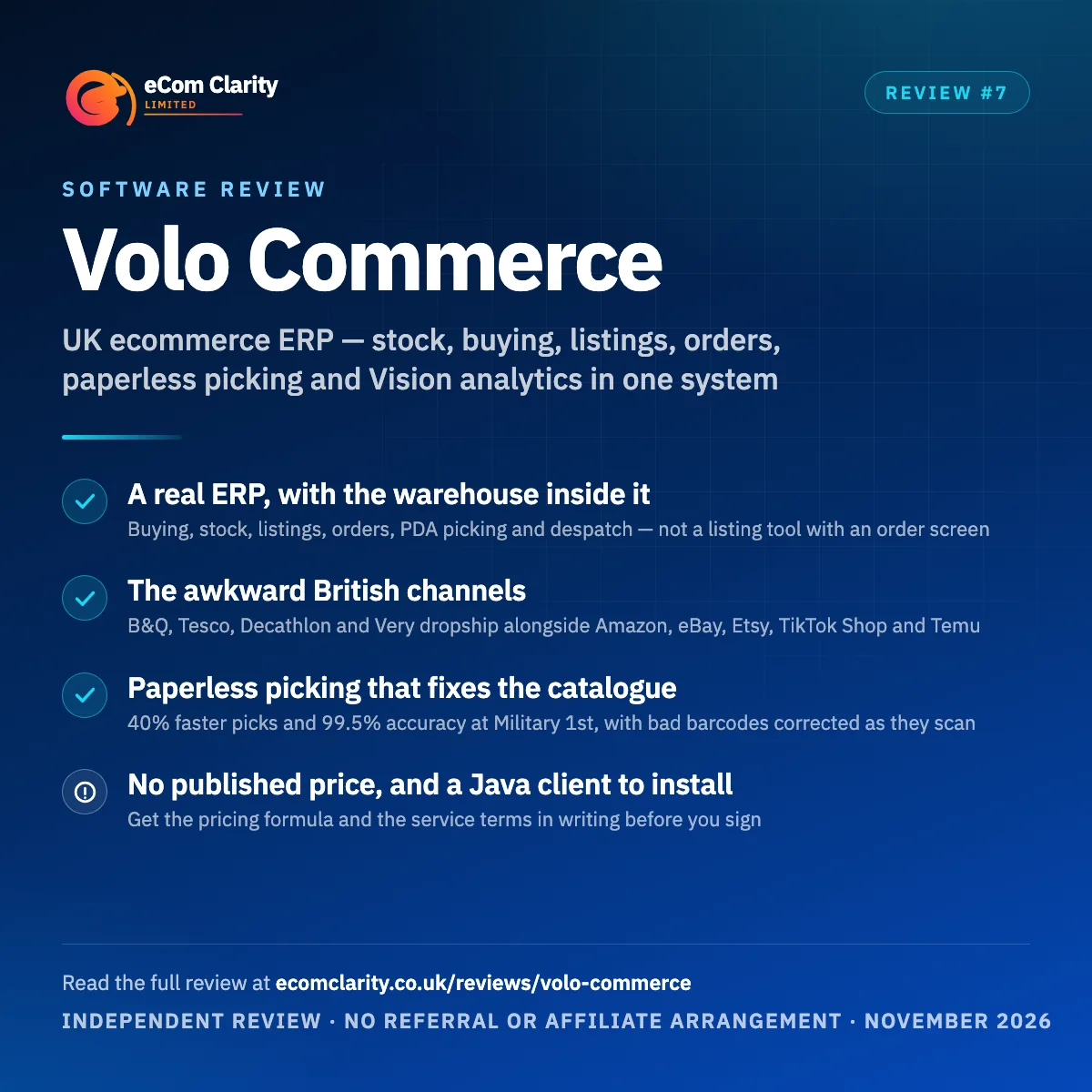
Volo Commerce is an ecommerce ERP: one system holding stock, suppliers, purchase orders, listings, orders, the warehouse process and despatch across marketplaces and web stores. The product is Volo Origin, and the analytics layer that comes with it is Volo Vision. That combination is the pitch, and it is a different one from the multichannel inventory tools it competes with: those orchestrate channels, this one also expects to run your buying, your stock and your pick floor.
The history matters to a buyer, because it explains the product’s shape. Volo launched as eSellerPro in 2006, when marketplace selling in Britain was eBay and little else, and was renamed Volo in 2015. FOG Software Group, a Constellation Software operating group, acquired the business in September 2019. Chris Farrelly, who founded and built eSellerPro, is still the CTO and chief architect; Paul Dicken is chief executive. The vendor says average staff tenure is more than five years, which for a company of this size is the most encouraging number on its own website.
What it is not is a cloud-first SaaS product you open in a browser tab. Origin is a Java application installed on the machine that uses it, on Windows, macOS or Linux; Vision is web-based, and the warehouse side runs on an Android PDA app. The servers, feeds and infrastructure sit on AWS and the vendor describes encryption at rest and in transit, but the client is still a client. That single fact shapes the rest of this review, and it is the thing to decide you are comfortable with before anything else.
The line that decides whether it fits
If your business is complicated — many channels, many catalogues, retailer dropship routes, a warehouse with staff who need telling where to walk — Volo has more of the plumbing built than most of the market, and two decades of British trading conditions baked into it. If your business is simple and you want to configure it yourself in an afternoon, the sales-led, services-heavy model here will feel like a step backwards.
How this review was done
This one has more first-hand material than any other review on this site, and it establishes the bias up front. eSellerPro was the ERP Adrian and I built the online side of XS Stock on. When we needed a warehouse system it did not have, the search took us to Peoplevox, and Chris Farrelly — eSellerPro’s founder and now Volo’s CTO — wrote the API connection between the two systems. It worked, it was supported, and it is still the clearest example I have of a vendor building the awkward thing a customer actually needed.
So treat the judgements about depth, the warehouse process and the way the company behaves as coming from running this software in a real business for years, and everything about price, contract, support terms and road map as coming from Volo’s published pages, read on the dates below so that you can check them and disagree with them.
- The platform, ERP, order management, listing management, sales channel, analytics and services pages, read 12 November 2026
- The integrations page and its channel, carrier, store, accounts and WMS lists, read 12 November 2026
- The About page for company history, ownership and leadership, read 12 November 2026
- The Terms and Conditions page, for what is and is not published about the contract, read 12 November 2026
- The developer and API pages, read 12 November 2026
- Case studies on the vendor’s own site: Military 1st on paperless picking (January 2025), Arks Global on TecCom (January 2026), Smarks (January 2026), and the TecAlliance certification announcement (July 2024)
- The vendor’s own ERP implementation timeline and cost article (March 2024)
- Our experience of running eSellerPro, and of the Peoplevox connection Volo’s CTO built for us
Two limits. We have not run the current 2026 build of Origin, so what follows about its present interface is read from the vendor’s pages and the two short videos it publishes, both from 2021. And the support portal sits behind Cloudflare and a login, so we could not read the knowledge base or the support articles a customer would see — which is itself worth knowing before you buy, and is covered under support.
What it actually does
The vendor’s own framing is twelve areas, which is a fair description of the ambition: supply, purchasing, marketplaces, web stores, accounts, CRM, inventory, listings, warehouse, orders, shipping, customer service — with Vision reporting across all of it. What follows is the version I would give a friend, in the order you meet it running a business.
Stock, suppliers and buying
One product record per item, with variations and kits treated properly: a kit holds its own stock and its components are deducted as it sells, which sounds routine until you shop for it. The vendor claims millions of SKUs without a loss of service, and describes custom fields and attribute filters so a big catalogue stays navigable. Purchasing runs to the SKU with supplier records, supplier prices per SKU — including the same SKU at different prices from different suppliers — goods-in against purchase orders, and rules to auto-create and auto-confirm purchase orders. Back-orders and drop-ship purchasing are first-class rather than bolted on.
Listings
A central product record pushed to marketplaces and web stores, with channel-specific rules, bulk tools and — the part that matters most in practice — scripting. Volo’s scripting is the mechanism for creating or revising listings in bulk across channels without copy and paste, and it is the feature customers name when they explain why they stayed. Images and video are hosted on Volo’s storage at no extra charge. Error detection before publication, variation and kit handling, and repricing tools sit alongside, and the vendor’s comparison pages put listing automation at the centre of the offer.
Orders and despatch
Orders arrive from the channels in near real time into one queue, then flow through pick, pack and despatch with barcode, label, invoice and marketing printing as part of the same step. Returns are handled properly — full or partial refunds, exchanges, credit — and the eBay housekeeping most platforms ignore is here: Questions and Disputes, and Feedback, inside the same interface. Operative auditing, so you can see who picked and packed what and how accurately, is part of the order module rather than a separate product.
The performance claim is specific and worth quoting exactly: Volo says Origin has processed more than 100 orders a minute without degradation, and customers have processed over £1m of GMV in a day at peak. I have not audited either figure, but they are the kind of claim that is checkable, and the architecture described — Java client, server-side order engine, AWS — is consistent with it.
The warehouse
Multi-location and multi-warehouse layouts, barcode tracking from receipt through despatch, pick lists and packing screens, and paper or paperless operation. The paperless pick module runs on Android PDA scanners: the picker sees the location, scans the item, and stock updates in real time. The detail I would not expect but rate highly is what happens when a barcode is wrong: the scan corrects the product database there and then rather than the mistake surviving to the next stock take. There is a section on what that did for one customer below.
Shipping
Sixty-plus shipping integrations by the integrations page’s count — the ERP page says more than fifty, and the difference is covered under the concerns. Couriers, aggregators and 3PLs are all in the list, carrier rules can be automated on many criteria, and documents including CN23 customs labels print from within the order flow. Volo Smart Shipper is the route when a direct carrier link is wanted rather than an aggregator. The vendor describes the carrier estate as Brexit-compliant, which by 2026 is table stakes rather than a differentiator, but it is not universal either.
Vision, the analytics half
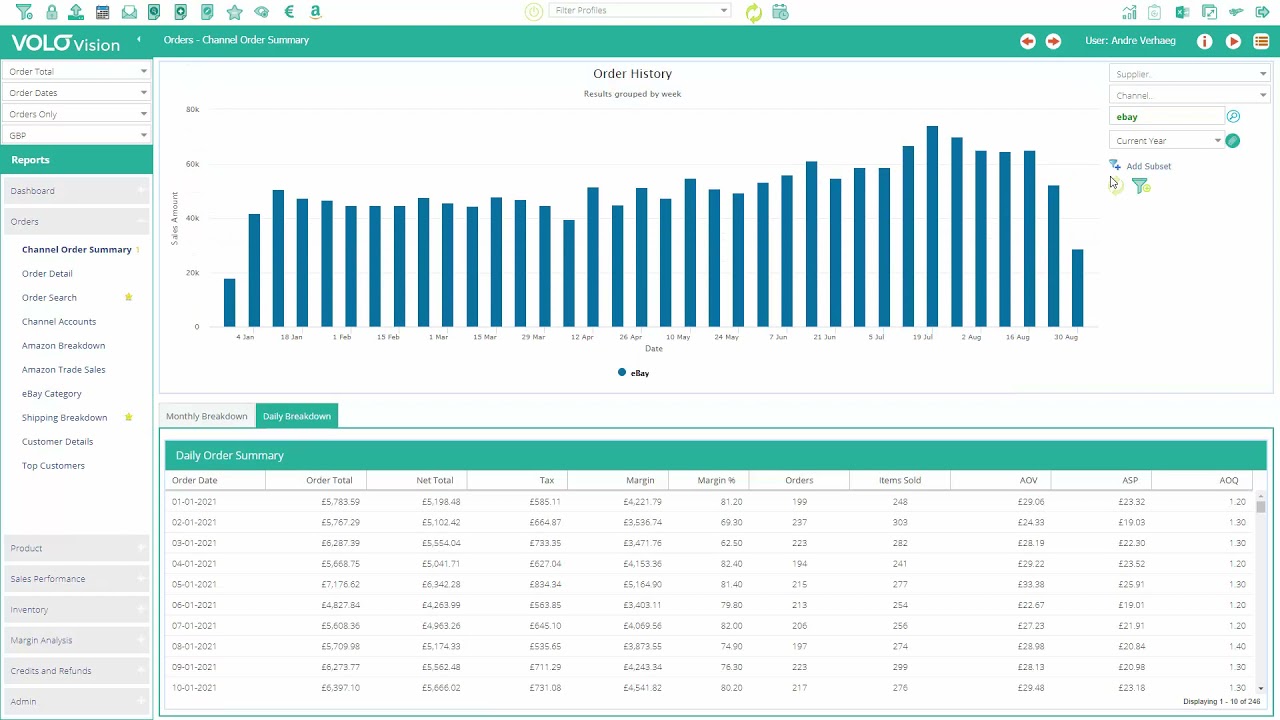
Vision collects the data Origin generates and turns it into dashboards and reports across sales, inventory, customers and margins, at headline and deep-dive level, sliced by channel, SKU, supplier, region or your own tags. Volo sells it as part of the platform rather than as a separate product, and it has been in its second generation since March 2020, which makes it the most settled part of the platform. For a business that has been living in exported spreadsheets, this is the feature that changes the job: the customers who talk about it talk about being able to answer questions without a weekly export.
The API and the feeds
There is a documented API with a developer area and credentials issued per customer, plus FTP capability for structured feeds in and out, which is how most real integrations with this platform happen — ours included. It is not a modern developer platform: authentication is HTTP basic with a username and password supplied by Volo, and there is no self-serve app ecosystem. What it is, is open enough that a determined integrator can build against it, which is how a warehouse system got connected to it in 2016 when nobody sold that connector.
Where it is genuinely strong
I have set up and run more than one of these platforms, and Volo is the one I would still put behind a complicated British multichannel seller. Five things earn that.
- Breadth with depth behind it. It is not a listing tool with an order screen attached, or an ERP that cannot print a label. Buying, stock, listings, orders, picking, packing, despatch, returns and analytics are all in the same system, which is what makes the automation possible.
- The awkward British channels. Retailer dropship routes — B&Q, Tesco, Very, Decathlon, The Range, Wowcher, Debenhams, Back Market — alongside the marketplaces, and accounts connections to Sage, Xero and QuickBooks. A US-first platform does not carry those routes.
- eBay and Amazon treated as businesses rather than data feeds. All eBay marketplaces with Managed Payments, Questions and Disputes and Feedback inside the system; Amazon including FBA, seller-fulfilled, Seller Fulfilled Prime and Amazon Business, and a full Amazon integration the vendor says has been running since 2006. Volo is a Gold Service Provider partner of eBay and says it has won eBay implementation and global early adopter awards.
- Scripting and bulk tooling. The ability to create or revise listings in bulk, and custom import/export routines, is the difference between a catalogue you can grow and one you maintain by hand. It comes up in every customer story the vendor publishes, which is a signal.
- People who stay. Twenty years in the same market, a CTO who founded it, average tenure over five years, and an owner — Constellation, through FOG — whose model is to buy and hold. That is not exciting, and it is exactly what you want from the system holding your orders.
And the automotive specialism is real rather than marketing: Volo was certified by TecAlliance as a TecCom Solution Integrator, and says it was the first UK ERP to be certified and the first ERP anywhere to integrate all four TecCom modules. If you sell parts, that is not a nice-to-have; it is the reason to take the demo.
The desktop client, and what it costs you
Origin is a Java desktop application. It installs on Windows, macOS and Linux, and the vendor supports all three. Vision is web-based, the warehouse app is Android, and the infrastructure behind it is AWS. So the honest description is a desktop client in front of a hosted platform, not a legacy on-premise system — but the client is the part your team touches every day, and it has consequences worth naming.
- Machines matter. New starters need the client installed and up to date before they can work. In a warehouse office with a spare desk and a temporary worker, that is a task, not a URL.
- Remote working depends on the connection back to the server rather than on a browser tab. Ask what the supported remote-access pattern is for your setup, and test it from a home connection before you sign.
- Releases are vendor-managed and the vendor describes regular releases under a testing and release programme. Ask how client updates get pushed, and what happens if a user skips one.
- Mixed Windows and Mac offices are supported on paper. Test it on the machines you actually have, including whatever runs the label printers.
Looking back, this was the limitation that mattered most to us: you used the software on the machine it was installed on, and the cloud changed what was possible for everyone. That is not an argument against Volo in 2026 — plenty of serious operations run it happily, and the trade-off buys a responsiveness a browser client of this complexity struggles to match — but it is the difference between this and the SaaS platforms it competes with, and it should be a conscious choice rather than something discovered in week three.
The paperless warehouse, with numbers attached
The paperless pick module is the part of Volo’s warehouse side worth understanding in detail, because it is where the platform stops being an order system with a pick list and starts changing how the floor works. Military 1st, a customer of more than fifteen years selling to dozens of countries, published its results on Volo’s site in January 2025: 40% faster picking, 99.5% picking accuracy, over 105 hours a week saved across the team, and roughly 90% fewer manual interventions.
Two things in that account are more interesting than the headline numbers. The first is training: the customer says the interface cut the time to get new staff productive, which in a warehouse with agency labour at peak is worth more than the speed. The second is the automatic database correction I mentioned earlier — a wrong, changed or missing barcode is fixed in Origin as the picker scans, so the catalogue gets better with every shift instead of degrading until the next stock take.
Treat the percentages as one warehouse’s experience with one product range, not a promise. The reason to include them is that they describe the mechanism honestly: real-time location and stock data plus enforced scanning. If your picking problem is that nobody knows where anything is, this fixes it. If your problem is the building layout or the shift pattern, no software fixes it.
The automotive edge: TecCom and the aftermarket
Volo is unusual in having a genuine specialism rather than a vertical landing page. In July 2024 TecAlliance certified it as a TecCom Solution Integrator — the vendor says the first UK ERP to be certified and the first anywhere to integrate all four TecCom modules: Order, Returns, E-Invoicing and CMD, the parts and pricing data feed. It works with Emotiv Corp on aftermarket ecommerce, and runs ecommotors, a retail platform and managed service for parts, tools and accessories.
What that means in practice is in the Arks Global story from January 2026: supplier catalogues, availability and purchase orders flowing through TecCom instead of being retyped, 70% less downtime on purchase orders by the customer’s reckoning, and a 45.6% increase in purchase orders in the year the integration went in. The founder’s line — that Volo made the front end simple enough that he did not need to be technical — is the part I would test hardest in a demo, because it is a services claim as much as a software one.
If you sell parts, ask to see TecCom running rather than a generic demonstration, and ask what the certification actually covers in your trading relationships. If you do not sell parts, read this section as evidence of how far the platform will go into a specific trading network, and skip to pricing.
What it costs, and why the model is the interesting part
Volo publishes no prices. Our directory records the commercial basis as quoted by channels and order volume, and that is as specific as the vendor gets in public. What the vendor does say, repeatedly and in slightly different words, is that its pricing model is designed to grow with you: on its alternatives page, “our pricing model incentivises you to grow your business, and doesn’t penalise you for being successful and exceeding thresholds”; on its Linnworks comparison page, “growth-friendly pricing” with “no surprises”, designed to avoid “an unexpected bill”.
That is a real differentiator if it is true, because the thing that upsets buyers at the competitors is exactly the threshold: order-volume tiers with overages that turn a good November into a January invoice. But an incentive not to penalise growth is only meaningful once you know what the bill is measured against. Channels, order volume, GMV, users, warehouses, SKUs and modules could each be the base, and “doesn’t penalise you for being successful” does not tell you which one moves.
Ask for the formula, not the philosophy
In the demo, ask what the fee is calculated on, what the bands are, what happens in a month that doubles, and whether a new channel or an extra warehouse changes the price. Ask for the last three increases customers on your shape received and what triggered them. A vendor that can answer those questions in writing is offering something valuable; a vendor that cannot is offering a slogan.
Budget for more than the licence. Implementation is chargeable professional services, the services catalogue includes custom reporting, creative design, health checks, training and strategy consulting, and custom development is explicitly part of the offer. In a model like this the software fee is the entry ticket and the relationship is the cost, so ask for the first-year all-in figure — platform, implementation, training, custom work and any third-party services — before you compare it with a published price elsewhere.
Implementation, and the services half of the offer
The vendor’s own guidance on its site sets the expectation honestly: in an article on ERP implementation it says a project rollout can take anywhere from three to nine months depending on customisation, with one to two months of scoping, two to three months of customisation and testing, two to three months of training and phased rollout, and a further two to three months of go-live and optimisation. It also quotes a rough SME figure of around £7,000 per user, which is generic ERP guidance rather than Volo’s own price — but it is the vendor choosing to publish those numbers, and that is fair.
Against that, the case studies lean on speed for small sellers: Smarks, in January 2026, says it was “up and running in days, not weeks”, with staff adapting quickly. Both can be true — a smaller catalogue with standard channels is a different project from a complex one with custom development — and knowing which shape you are is the most useful planning decision you can make before talking to sales.
Implementation, account management and support are distinct functions at Volo rather than one desk wearing three hats: professional services sells project work, the platform pages point at an account management team, and the support portal is separate again. The services catalogue — custom reporting, creative design, health checks, training, strategy, digital marketing — is genuinely broad, and for a seller without an in-house analyst it is the difference between buying software and buying an outcome. The risk is the same as the benefit: when services are part of the product, the quality of your account team matters as much as the release notes.
Get the scope, not the relationship
Before you sign, ask exactly which of the things you need are standard, which are configuration, and which would be custom development — then have the custom work scoped, priced and dated in writing. Custom development is a genuine strength of this vendor, and it is also the line item that turns an implementation into an open-ended project if nobody defines where it ends.
Support: a team that stays, behind a portal you cannot read yet
Support is the part of Volo I would worry about least and the part a buyer can see least of. The help portal at help.volocommerce.com has account management behind it and phone lines in Cheltenham and New York, so there is a number to ring on either side of the Atlantic. What sits behind the portal, meaning the knowledge base, the articles and the ticket process, stays closed until you are a customer, and there is no public status page either; the obvious address does not resolve.
None of that reads as a warning to me. A private portal is how a vendor selling to established businesses tends to work, and plenty of twenty-year-old companies never got round to a status page. It does mean support is the one thing on this page you cannot check before you sign, which makes the demo questions below worth more here than they would be against a competitor whose help centre you can read.
Where the confidence comes from is the people. Volo has customers of fifteen years who still talk about new features landing quickly. One credits the company with a TecCom integration straightforward enough to run without technical staff. A customer who joined in January 2026 described “thorough, clear communication and responsiveness”. Average staff tenure is over five years, which in my experience is what keeps a support line worth ringing. None of it is an SLA and you should ask for one, but it is the part of support a contract cannot buy.
Integrations: a wall, an API, and counts that move
The integrations page is a logo wall rather than a directory, and the vendor says plainly that the list is not exhaustive and that a missing channel or carrier is a conversation. That is honest, and it makes the wall more useful than a padded catalogue. What it shows, from our reading on 12 November 2026:
| Group | What the vendor names |
|---|---|
| Marketplaces | Amazon (all marketplaces, FBA, seller-fulfilled, Seller Fulfilled Prime, Amazon Business), all eBay marketplaces with Managed Payments, Etsy, TikTok Shop, Temu, Cdiscount, ManoMano, OnBuy |
| UK retailer dropship | B&Q, Tesco, Very, Decathlon, The Range, Wowcher, Debenhams, Back Market |
| Web stores | Shopify, Magento, Visualsoft, EasyShop, Commet |
| Accounts | Sage, Xero, QuickBooks |
| Warehouse | PeopleVox, which is how our own warehouse was connected |
| Shipping | Couriers, aggregators, consolidators and 3PLs — sixty-plus by the integrations page, “more than fifty” on the ERP page — including Metapack, with Smart Shipper for direct carrier links |
| Method | Documented API with per-customer credentials, plus FTP for structured feeds |
The counts are worth pinning down rather than repeat. The ERP page says shipping management has “more than 50 integrations”; the integrations page says more than 60; the Linnworks comparison page says “over 50 shipping carriers”. None of those is dishonest and the exact number will depend on whether aggregators and 3PLs are counted, but a buyer checking a specific carrier should ignore all three numbers and check their own list by name.
The API deserves its own sentence because it is the reason this platform can be extended past what the vendor sells. It is documented, it has a developer area, and credentials are issued per customer. It is also old-fashioned — HTTP basic authentication with a username and password in the request header — so if your security review demands modern token-based access, that is a conversation to have early rather than an assumption to carry into signing.
The areas of concern, in one place
None of these is a reason to walk away — I would still recommend the platform on the right brief — but each one is cheaper to resolve before you sign than after.
- No published price, and no published contract terms. The website terms cover the website only and say service terms can be obtained from the business premises. Ask for the contract, the term, the notice period and the uplift mechanism before you discuss anything else.
- The desktop client is a real operational decision. Installation, updates, remote access and a mixed Windows and Mac estate all need testing on your machines, not on a demo laptop.
- The platform is twenty years old, which is a strength for depth and a question for pace. Ask what shipped in the last year, what is on the road map, and how releases reach you.
- The website contradicts itself in small ways: fifty shipping integrations on one page and “more than 60” on another, shipping carriers counted as “over 50” on a third, and an aftermarket partner that appears as both Emotiv Corp and Emotiv Data. Each is trivial; together they mean verify specifics in writing rather than rely on a page.
- Support cannot be evaluated before purchase. No status page, no public knowledge base, no SLA. Ask for the response-time commitment and where it is written.
- The services model means quality rides on your account team. Ask who your account manager will be after go-live, and what happens when they leave.
- Vision is sold as part of the platform rather than on its own, so the analytics come with the ERP and not without it. Worth knowing if the reporting is what attracted you.
- The product footage the vendor publishes is two short videos from 2021. There is no trial and no self-serve demo, so you will be evaluating the current build through a salesperson. Insist on a live walkthrough of your own catalogue.
Who it suits, and who it does not
A good fit when
- You are an established UK multichannel seller — marketplaces plus web stores plus, often, retailer dropship — and the join between them is the work
- Your catalogue is complicated: variations, kits, supplier-specific pricing, back-orders, drop-ship
- You run your own warehouse and want the pick floor inside the same system as the orders, with paperless picking on PDAs
- You sell automotive parts, or through any trading network where TecCom-style ordering matters
- You want people to call, custom development to be possible, and implementation done with you rather than to you
- You value an owner that buys and holds over a start-up that might pivot, and a vendor whose staff tend to stay
Not such a good fit when
- You want to sign up, trial and configure it yourself. This is a sales-led, services-led product and it will feel slow
- You need a browser-first platform where everyone can work from anywhere with no client to install
- You are under a hundred orders a day with a simple catalogue: the ERP is more than the job, and a lighter tool will do
- Your operation is outside the UK and Europe with global-first ambitions, where a platform built for British trading conditions is less of an advantage
- You need published pricing to build a business case before you will take a call
- Your evaluation depends on reading the help centre, reading the contract, or watching current product video before you speak to anyone
What to ask Volo in a demo
- Show me the current build, on my catalogue, with my variations and kits — not the 2021 videos.
- What is the fee calculated on, what are the bands, and what happens in a month that doubles?
- What did customers on my shape pay in year one, all in — platform, implementation, training, custom work?
- Which of my channels and carriers are native, which are FTP or API, and who supports each one when it breaks?
- What is the contract term, the notice period, and the uplift mechanism on renewal? Give me the service terms you keep at the premises.
- Who implements this, who is my account manager after go-live, and what happens when they leave?
- What is your response-time commitment for a stopped despatch, and where is it written?
- How do client releases get pushed, and what is supported for a Mac user, a Windows user and someone working from home?
- Show me a wrong-barcode scan and what happens to the product record. Show me a mis-pick and a duplicate order.
- What has shipped in the last twelve months, and what is next for the warehouse and the API?
The verdict
Volo Commerce is the deepest fit I know for a British multichannel seller whose business is genuinely complicated. It holds the buying, the stock, the listings, the orders, the pick floor and the despatch in one place, it has the awkward channels and the retailer dropship routes that British sellers need, and two decades of trading conditions are in the code rather than in a case study. Vision, the reporting half, sitting inside the same system is the difference between guessing and knowing, and the paperless picking module earns its keep on a real floor.
It is also a product you have to buy like a partnership rather than a subscription. No published price, no published contract terms, support you cannot read before you buy, product video from 2021 and a Java client to install. None of those are dishonest, and the growth-friendly pricing the vendor describes would be a genuine advantage over order-volume tiers with overages — but only if you get the formula and the contract in writing before you sign.
The thing I keep coming back to is the people. A founder still architecting his own platform, average tenure over five years, and a case-study history that goes back fifteen years with the same customers. When we needed a connection this platform did not have, its founder wrote one that worked. You cannot buy that from a feature list, and it is the main reason I would still put Volo at the front of a shortlist for a complex UK operation.
Would I recommend it? Yes, on that brief: an established multichannel seller, a complicated catalogue, a warehouse to run, and an appetite for a relationship rather than a sign-up. Test the desktop estate first, get the pricing formula and the service terms in writing, and then judge it against a competitor whose price you can see. If it is the right shape, it will still be running your business when the SaaS platform you nearly chose has been acquired twice.
Evidence and sources
- Platform, ERP, order management, listing management, sales channel, analytics and services pages · Read 12 November 2026
- Integrations page: channels, dropship routes, web stores, accounts, WMS and carriers · Read 12 November 2026
- About page: eSellerPro 2006, Volo 2015, FOG Software Group September 2019, leadership and staff tenure · Read 12 November 2026
- Terms and Conditions page, including the clause that service terms are available from the business premises · Read 12 November 2026
- Developer and API pages: documented API, developer area, HTTP basic authentication, FTP feeds · Read 12 November 2026
- eBay and Amazon strategic partner pages: Gold Service Provider status, the awards and the Amazon integration since 2006 · Read 12 November 2026
- Military 1st paperless picking case study, published 16 January 2025 · Read 12 November 2026
- Arks Global TecCom case study, published 13 January 2026 · Read 12 November 2026
- Smarks customer story, published 27 January 2026 · Read 12 November 2026
- TecAlliance TecCom certification announcement, published 1 July 2024 · Read 12 November 2026
- Volo Vision 2 release post, March 2020, and the Vision pages · Read 12 November 2026
- ERP implementation timeline and cost article, published 28 March 2024 · Read 12 November 2026
- Vendor video: A glance at Volo Vision (2021) and the Volo Commerce explainer (2021), on Volo’s own channel · Viewed 12 November 2026
- Our experience of running eSellerPro, and of the Peoplevox connection built by Volo’s CTO · Author’s own
Independence
eCom Clarity was not paid for this review and Volo Commerce has no influence over its content. There is no referral or affiliate arrangement. One disclosure does not normally apply: eSellerPro, the product Volo was built from, was the ERP our own business ran on, and we still count the connection its founder wrote for us as a good piece of work. Everything read from Volo’s pages is dated in the sources list, and where a judgement comes from operating the product rather than from the vendor’s paperwork, it says so.
Spotted something wrong, or used this product yourself? Tell us and we will correct or add it.